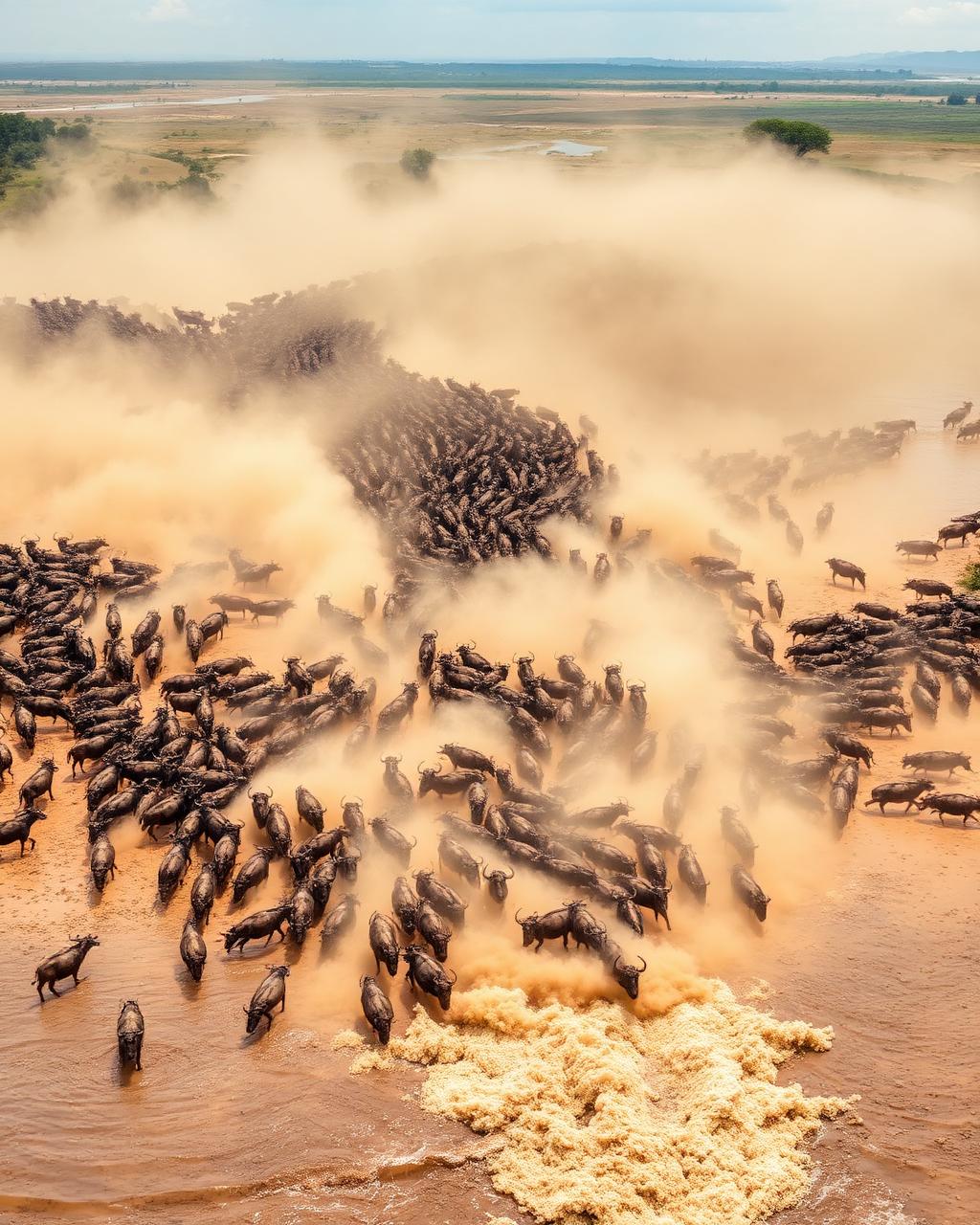
Wildebeest herds crossing the Serengeti plains during the Great Migration

Migrations

Serengeti Wildebeest Migration Safari

Two million animals on one unbroken circuit. Here is where they are each month, how long you should stay to actually see it, and why we fly to the north.

Why it began

A rhythm written by volcanoes and rain

The migration is not a journey with a destination — it is a loop that the Serengeti–Mara ecosystem has forced on the herds for hundreds of thousands of years. Ash from the Ngorongoro Highlands volcanoes settled over the southern plains and set hard, creating a shallow, mineral-rich soil that supports only short grass. That grass is unusually high in calcium and phosphorus — exactly what a wildebeest cow needs to carry and feed a calf.

But that soil cannot hold water. When the short rains arrive in November the southern plains flush green and the herds pour down to calve. When the rains stop in May the plains dry out within weeks and the same herds are pushed north-west toward the taller, wetter grasslands of the western corridor and, eventually, the permanent water of the Mara River.

Why it still exists

One of the last unfenced ecosystems on earth

Almost every other great herd migration on the planet has been broken by fences, roads, farmland and settlement. This one survives because roughly 30,000 square kilometres of connected, protected land — Serengeti National Park, the Ngorongoro Conservation Area, Maswa, Grumeti, Ikorongo and the Maasai Mara — were kept open to movement.

The Ngorongoro Conservation Area is central to that: it is a multiple land-use area where Maasai pastoralists and wildlife share the same grazing, which is why the calving grounds were never ploughed. Tourism revenue and community conservancy agreements are now what keep the corridors unfenced, which is a plain fact worth knowing when you pay your park fees.

Season by season

Where the herds are, month by month

The herds do not read calendars — rainfall shifts these windows by two or three weeks each year. We confirm current herd positions before we finalise any migration itinerary.

December – March Ndutu, Kusini, southern short-grass plains

Calving season, southern Serengeti & Ndutu

Around half a million calves are born in roughly three weeks on the mineral-rich volcanic grasslands. Predator action is at its most intense of the entire year, and the herds are concentrated in open country that is easy to read and photograph.

Minimum 2 nights in Ndutu / southern Serengeti — 3 is better.

April – May Moru Kopjes, Seronera, central Serengeti

Long rains, herds moving north-west

Green, quiet and excellent value. Columns of wildebeest string through the central Serengeti on their way to the western woodlands. Some roads are slow and a few camps close, so routing matters more than usual.

Minimum 2 nights in central Serengeti.

June – July Grumeti Reserve, western corridor

Western Corridor & the Grumeti

The rut is in full voice and the herds face the Grumeti River and its very large crocodiles. Crossings here are less predictable than the Mara River, but the build-up along the riverine forest is spectacular.

Minimum 2 nights in the western corridor.

August – October Kogatende, Lamai Wedge, Nyamalumbwa

Mara River crossings, northern Serengeti

The scene most travellers picture: thousands of animals massing on the bank, hesitating, then pouring across. Crossings are unpredictable — they may happen twice in a morning or not at all for two days. This is the season where patience is the whole strategy.

Minimum 2 nights at Kogatende / Lamai — we strongly recommend 3.

November Lobo, Seronera, moving toward Ndutu

Short rains, the herds turn south

The first storms pull the herds back down the eastern side of the Serengeti. Skies are dramatic, the parks are quiet, and the year begins again.

Minimum 2 nights in central or northern Serengeti.

Our booking requirement

Two nights minimum in any migration area

We do not sell single-night stops in Ndutu, the western corridor or the northern Serengeti. It is the one rule we hold to, and it is not an upsell — it is the difference between seeing the migration and driving past where it was.

  • Two nights gives you a full day in the area plus an arrival afternoon and a departure morning — three game-viewing windows instead of one.
  • Your guide can act on yesterday's information: which direction the herds moved, which crossing point they are massing at.
  • River crossings in the north routinely fail to happen on any given day. Three nights at Kogatende in August is our strong recommendation.
  • Less driving between camps means more time watching, and calmer, better photography light at both ends of the day.

Plan by your dates

Where should the herds be in your month?

Tap the months you could travel. We map them to the migration area the herds should be in, the minimum nights we require there, and whether to fly or drive.

At a glance

The migration seasons, on one page

Months, where the herds are, and our minimum-stay rule for each migration area. Save it as a PDF to share with your travel companions.

MonthsWhere the herds areSeasonMinimum stay
December – MarchNdutu, Kusini, southern short-grass plainsCalving season, southern Serengeti & Ndutu2 nights in Ndutu / southern Serengeti — 3 is better.
April – MayMoru Kopjes, Seronera, central SerengetiLong rains, herds moving north-west2 nights in central Serengeti.
June – JulyGrumeti Reserve, western corridorWestern Corridor & the Grumeti2 nights in the western corridor.
August – OctoberKogatende, Lamai Wedge, NyamalumbwaMara River crossings, northern Serengeti2 nights at Kogatende / Lamai — we strongly recommend 3.
NovemberLobo, Seronera, moving toward NdutuShort rains, the herds turn south2 nights in central or northern Serengeti.

Why we fly north

Fly to the northern Serengeti — drive the rest

Arusha to Kogatende by road is 9–11 hours of corrugated gravel, and you have to do it again on the way out. By light aircraft it is roughly two hours. On a seven-day trip, flying gives you back almost two full days — and those are precisely the days you need spare when you are waiting for a crossing.

We normally fly Arusha or Zanzibar to Kogatende / Lamai, where your guide and 4x4 meet you at the airstrip, then fly out again from Seronera or Kogatende. Short-hop flights also open up the calving grounds at Ndutu in one hop from the coast.

  • Two hours in the air instead of a day and a half on the road, each way.
  • Arrive fresh — first game drive the same afternoon you leave the coast.
  • Aerial views of the herds and the Serengeti plains on approach.
  • Easy to combine the northern Serengeti with Zanzibar without backtracking through Arusha.
  • Driving still makes sense for Tarangire, Manyara and Ngorongoro — the crater rim is only a few hours from Arusha.

Good to know

Migration questions we are asked most

Why do we insist on at least two nights in a migration area?

The migration is a moving animal, not a fixed attraction. A single night gives you one afternoon and one morning drive — if the herds shift 20km or a river crossing does not happen that day, you have missed it. Two nights doubles your game-drive windows and lets your guide follow up on what the herds did yesterday. In the northern Serengeti during crossing season we push for three.

Can you guarantee a river crossing?

No honest operator can. We can position you in the right area at the right time of year, in a camp within reach of the crossing points, and give you the days needed for the odds to work in your favour. Everything beyond that belongs to the wildebeest.

Why do you recommend flying for the northern Serengeti?

Arusha to Kogatende is a full day — often 9 to 11 hours — on rough road. The flight is about two hours. Flying converts two wasted driving days into two extra game-viewing days, which is exactly what you need when you are waiting on a crossing. We use a light aircraft to Kogatende or Lamai and a 4x4 with your guide waiting at the airstrip.

Is the migration worth seeing outside crossing season?

Yes. Calving season in the south is arguably the richer wildlife experience: enormous concentrations, constant predator activity, and far fewer vehicles than the northern crossings in August.

Plan further

Keep reading before you choose your dates

Ready to time your safari around the herds?

Tell us your travel window and we will tell you honestly where the migration should be, how many nights you need, and whether to fly or drive.

Request my migration safari